
Objective measurement, not opinion.
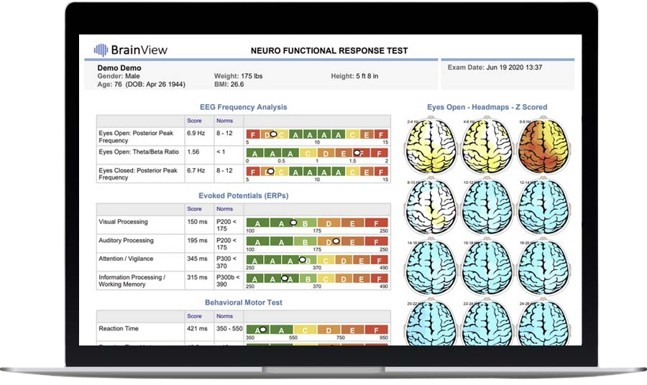
Cortivex Medical uses quantitative EEG (QEEG) to measure brain electrical activity and compare it against a normative reference database — turning brain function into standardized, objective data a physician can interpret.
What is QEEG?
An electroencephalogram (EEG) records the brain's electrical activity. Quantitative EEG (QEEG) applies statistical analysis to that recording and compares it against a database of normative values, producing objective, quantified measures rather than a subjective read.
Structural imaging vs. functional assessment.
CT and MRI image the brain's structure and are essential for ruling out emergencies such as bleeding or fracture. They are not, however, designed to measure how the brain is functioning — and they are frequently normal in mild traumatic brain injury. QEEG measures function, adding objective data the clinical team can weigh alongside imaging, history, and examination.
Conventional CT & MRI
Excellent at detecting structural damage and ruling out emergencies — but frequently normal in mild TBI. In mild traumatic brain injury, only about 10% of CT scans and roughly 30% of MRI scans show abnormalities, and conventional imaging is insensitive to diffuse axonal injury, the most common injury in mild TBI.
- · Images anatomy and structure
- · Essential for emergency rule-out
- · Not designed to measure function
Functional QEEG assessment
Measures the brain's electrical activity — a functional layer of information that structural imaging is not designed to capture — adding objective, quantified data to the clinical picture.
- · Quantifies brain electrical activity
- · Compared to normative reference data
- · Complements, not replaces, imaging
Imaging sensitivity figures are drawn from peer-reviewed literature on mild traumatic brain injury and diffuse axonal injury; exact rates vary by study, protocol, and population.
What the exam is like.
A QEEG assessment is designed to be straightforward and stress-free. Here's what to expect.
Non-invasive
No needles, no radiation, no injected contrast — just sensors that read activity from the scalp.
Comfortable sensor cap
A soft cap with EEG sensors records your brain's electrical activity while you sit quietly.
In clinic or at your location
Performed at our Dallas clinic, or mobile at your home or office across DFW and Houston.
Limited, comfortable time
The exam takes a comfortable, limited amount of time. Nothing about it is painful.
What you receive.
Findings are compiled into a comprehensive report — approximately 30 pages — reviewed by a qualified neurologist and prepared for clarity in both clinical and legal settings. Reports are typically delivered within 48 hours of the completed exam.
Objective data, presented clearly
Quantified findings laid out so the underlying measurements are visible, not hidden behind jargon.
Neurologist review
Every report is reviewed by a qualified neurologist before it leaves our clinic.
Built for clinical & legal readers
Formatted so treating physicians and attorneys can both navigate the findings.
Rapid turnaround
Reports are typically delivered within 48 hours of the completed exam.
Reports document objective findings. They are not a guarantee of any medical or legal outcome.
Built on FDA-cleared technology.
The brain assessment technology used by Cortivex Medical is cleared by the U.S. Food and Drug Administration as an aid in the clinical evaluation of patients. Cortivex Medical technicians are trained in proper administration of the assessment, and every report is independently reviewed by a board-certified neurologist in our network.
Cortivex Medical provides assessment services and reports. We do not provide treatment, prescriptions, or ongoing medical care. Our reports are intended to support — not replace — the clinical judgment of treating physicians.